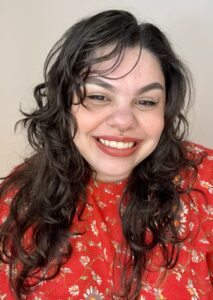
Adriana Rosales, MSW (she/her)
Psychotherapist
Who I Am and How I Practice
I am a queer, multicultural Latine therapist whose work is shaped by my lived experience of holding multiple marginalized identities. I am neurodivergent, grew up impoverished, and was raised within a multicultural household in a society that often communicated who was valued and who was disposable. I live in a body that does not align with dominant norms, under political and social regimes that have been openly hostile toward Latine communities. I have experienced firsthand how racism, microaggressions, surveillance, and structural barriers accumulate over time. These are not abstract concepts to me. They are lived realities that have shaped how I move through the world, how I survive, and how I understand pain.
My work is grounded in liberation psychology and anti-colonial practice, which recognizes that we live within systems that profoundly shape our stress, coping, and sense of self. Many of the ways we survive, such as hypervigilance, emotional numbing, people-pleasing, or withdrawal, are not signs of failure. They are intelligent and adaptive responses to harm, scarcity, and ongoing oppression. I approach the mind and body as protective and deserving of care rather than correction or perfection.
In therapy, I prioritize collaboration, consent, and pacing that honors your nervous system and lived experience. I aim to create a space that does not replicate the same pressures many experience outside of the therapy room. Our work together is not about fixing you or molding you to fit dominant expectations. It is about supporting agency, reclaiming choice, and reconnecting with parts of yourself that may have been suppressed to survive. Healing is deeply personal, and I aim to create a space where your full humanity and autonomy is recognized and respected.
Who I Am a Good Fit For
I work best with individuals who hold marginalized identities and who are navigating the impact of systemic oppression, intergenerational trauma, and ongoing barriers to safety and belonging. This includes LGBTQIA2S+ individuals, neurodivergent folx, people from multicultural or immigrant backgrounds, Latine individuals, BIPOC individuals, and those who grew up with economic scarcity or instability.
I also provide relationship therapy to humans who participate in non-monogamous relationship structures, kink+ communities, mixed neurotype relationships and other relational or identity expressions that are frequently misunderstood, stigmatized, or pathologized within mainstream mental health systems. My approach is affirming of diverse ways of loving, relating, and existing, and I hold these identities with respect, curiosity, and cultural humility.
Many of the people I work with are consciously trying to break generational cycles, unlearn internalized narratives imposed by oppressive systems, and redefine success, safety, and worth on their own terms. If you are seeking therapy that names power, history, and social context, and that understands coping as a response to harm rather than a flaw, this space may be a supportive fit.
Modalities, Community Roots, and Anti-Colonial Lens
Before entering clinical work, I held multiple roles at a multicultural, immigrant-centered, and predominantly Latine community center. In my later role as a first and second-grade instructor, I created and facilitated social-emotional learning (SEL) lesson plans that centered emotional literacy, consent, and nonjudgmental exploration of feelings. I supported children in learning how to name emotions, set boundaries, and express themselves within an affirming and culturally responsive environment. This work continues to inform my belief that emotional knowledge, relational safety, sense of autonomy and liberation are cultivated early and sustained through community.
In my clinical practice, I work from an insight-oriented lens and draw from Internal Family Systems (IFS), Acceptance and Commitment Therapy (ACT), Health at Every Size (HAES), Cognitive Behavioral Therapy (CBT), Dialectical Behavior Therapy (DBT), somatic practices, mindfulness, and strengths-based approaches. Rather than applying these models rigidly, I engage them critically and adapt them through an anti-colonial lens. This involves questioning whose experiences these frameworks center, recognizing their limitations, and reshaping tools to align with your lived, cultural, relational, and political realities.
In practice, this may look like using skills as flexible supports, centering your autonomy in how tools are applied, and acknowledging that safety and regulation are deeply contextual rather than universal. Somatic and mindfulness practices are offered with choice and attunement, recognizing that the body holds both wisdom and memory shaped by history. CBT and DBT skills are framed as resources that can support emotional literacy, boundaries, and resilience without reinforcing shame, self-blame, or compliance with oppressive norms.
At the core of my work is a belief that healing and liberation are interconnected. Therapy can be a space to make meaning of harm, strengthen your capacity to respond rather than react, and build a life that feels more aligned with your values, needs, and sense of self. You do not have to carry this alone. I am here to walk alongside you as you define what healing and liberation look like for you.
My specialties include but are not limited to:
• Depression and anxiety
• Trauma, PTSD, and C-PTSD
• Neurodivergence including ADHD and Autism
• Migration and first-generation experiences
• Acculturative stress
•LGBTQIA2S+
• Race and Gender-based violence
• Gender and/or sexuality exploration
• Kink/BDSM and Polyamory/Non-monogamy
Adriana earned her Bachelor of Social Work (BSW) from Northeastern Illinois University, where being in a deeply diverse community shaped how she has come to understand care and connection. Additionally, she completed her Master of Social Work (MSW) at the University of Michigan, where her clinical training emphasized reflection on privilege, oppression, diversity, and social justice in practice.